


RE/MAX VIP TEAM · JOURNAL · OCTOBER 28, 2026
Bank of Canada Raises Rates: What It Means for You
A quarter-point hike, explained in real dollars for GTA homeowners, buyers and sellers.
By Andrei Baiborodin, Sales Representative · RE/MAX VIP TEAM · 5-minute read
On October 28, 2026, the Bank of Canada raised its key interest rate by a quarter point, to 2.50%. It is the first increase since 2023, and it ends a long stretch of cuts and holds. If you own a home, are buying one, or are thinking about selling in the GTA, here is what this change means in real dollars, without the jargon.
Below you will find what changed and why, real-dollar examples for variable, fixed and line-of-credit borrowers, what it means if you are buying or selling, and what may come next. Every number is an estimate, so treat it as a starting point for a conversation with your lender, not a final answer.
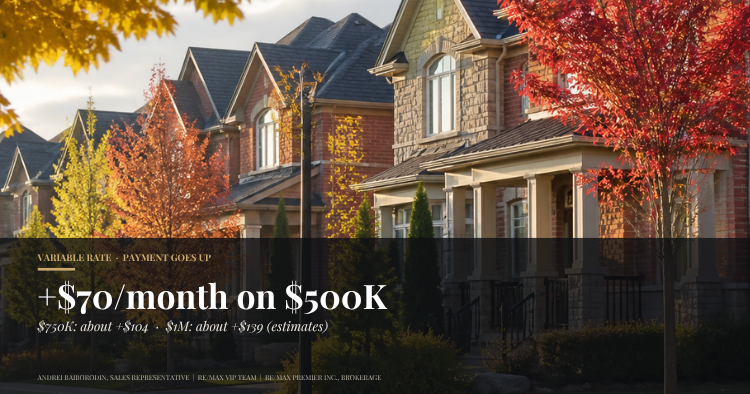
• Variable rate, payment changes: about +$70 a month per $500,000
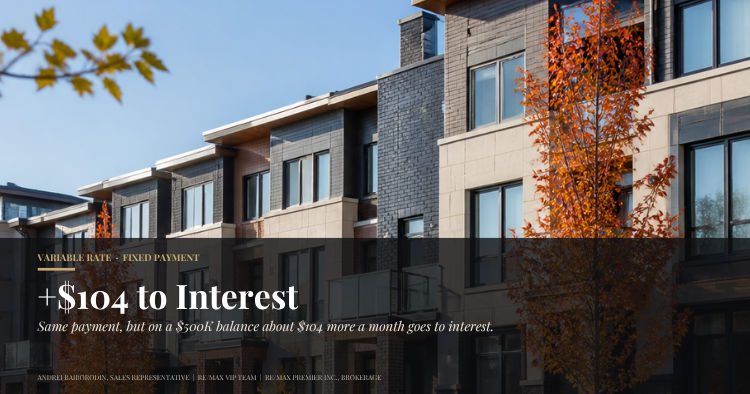
• Variable rate, fixed payment: same payment, about $104 more to interest on $500,000
• Fixed rate: $0 change until renewal
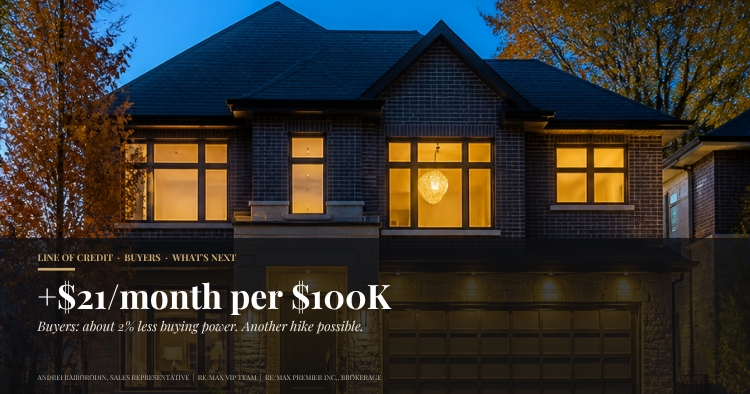
• Line of credit: about +$21 a month per $100,000
• Buyers: roughly 2% less buying power
THE BASICSWhat actually changed
The Bank of Canada sets the overnight rate. Banks use it to price their prime rate, and prime drives variable-rate mortgages and home equity lines of credit (HELOCs). When the Bank moves by 0.25%, prime usually follows within a day or two.
Fixed-rate mortgages are different. They follow bond yields, which often move before the Bank announces anything. So the effect depends on the kind of mortgage you have.
VARIABLE RATE · PAYMENT GOES UPIf your payment changes with prime
If your payment goes up when prime goes up, here is roughly what a 0.25% increase looks like:
| Mortgage balance | Per month | Per year |
|---|---|---|
| $500,000 | about +$70 | about +$840 |
| $750,000 | about +$104 | about +$1,250 |
| $1,000,000 | about +$139 | about +$1,670 |
Estimates: 0.25% increase, 25-year amortization.
Noticeable, but for most households it is manageable when it is planned for.
VARIABLE RATE · FIXED PAYMENTIf your payment stays the same
Many Canadian variable mortgages keep your payment the same. In that case, nothing changes on your bank statement, but more of each payment goes to interest. On a $500,000 balance, about $104 more a month goes to interest and less to principal. Your mortgage gets paid off a little more slowly.

FIXED RATEIf you have a fixed rate
Your payment does not change today. Your rate is locked until renewal. The real question is what rates look like when your term ends, so if you renew in the next 12 months, start the conversation with your lender or mortgage broker early.
LINE OF CREDIT · BUYERS · SELLERSHome equity line of credit
A HELOC usually moves with prime right away. Expect about +$21 a month for every $100,000 you owe, on an interest-only basis.
What it means for buyers
Buyers qualify under the federal stress test, so a higher rate lowers the maximum amount you can borrow. A 0.25% increase cuts buying power by roughly 2%. On a $1,000,000 purchase budget, that is about $20,000 less.
- Get a pre-approval and ask your lender to hold the rate. Many holds last 90 to 120 days.
- Build a little room into your budget instead of stretching to the maximum.
- Focus on the home and the neighbourhood you want long term. Rates change; a good location stays good.
What it means for sellers
Some buyers will hesitate, and some will adjust their budgets. That makes pricing and presentation more important than ever. Homes that are priced right from day one and look their best still sell well, even in a cautious market. Homes that start too high tend to sit, and then sell for less.
If you are thinking about selling in the next year, a clear plan now (timing, pricing and preparation) puts you ahead of the sellers who wait to see what happens.
LOOKING AHEADWhat could happen next
The Bank said further increases are possible if inflation does not come down as expected. Nobody can predict rates with certainty, so the best approach is to plan for a range. Ask yourself: if rates go up another 0.25% or 0.50%, does my budget still work? If the answer is yes, you can make decisions with confidence.

MY TAKEPlan, don't panic
A quarter-point move is not a crisis, but it is a good reason to review your mortgage, your budget and your plans for the next year.
THINKING ABOUT SELLING?
Find out what your home could sell for today.
Or ask how a rate change affects your plans. Call or text Andrei: 416-562-3021
Andrei Baiborodin, Sales Representative | RE/MAX VIP TEAM | RE/MAX Premier Inc., Brokerage
Examples are estimates (25-year amortization, 0.25% increase). General information only, not advice. Speak with your lender or a licensed mortgage professional about your situation.
Sources: Bank of Canada interest rate announcement, October 28, 2026 (bankofcanada.ca); stress test: Office of the Superintendent of Financial Institutions (osfi-bsif.gc.ca).
AI-assisted.